The story
Life in Atascadero
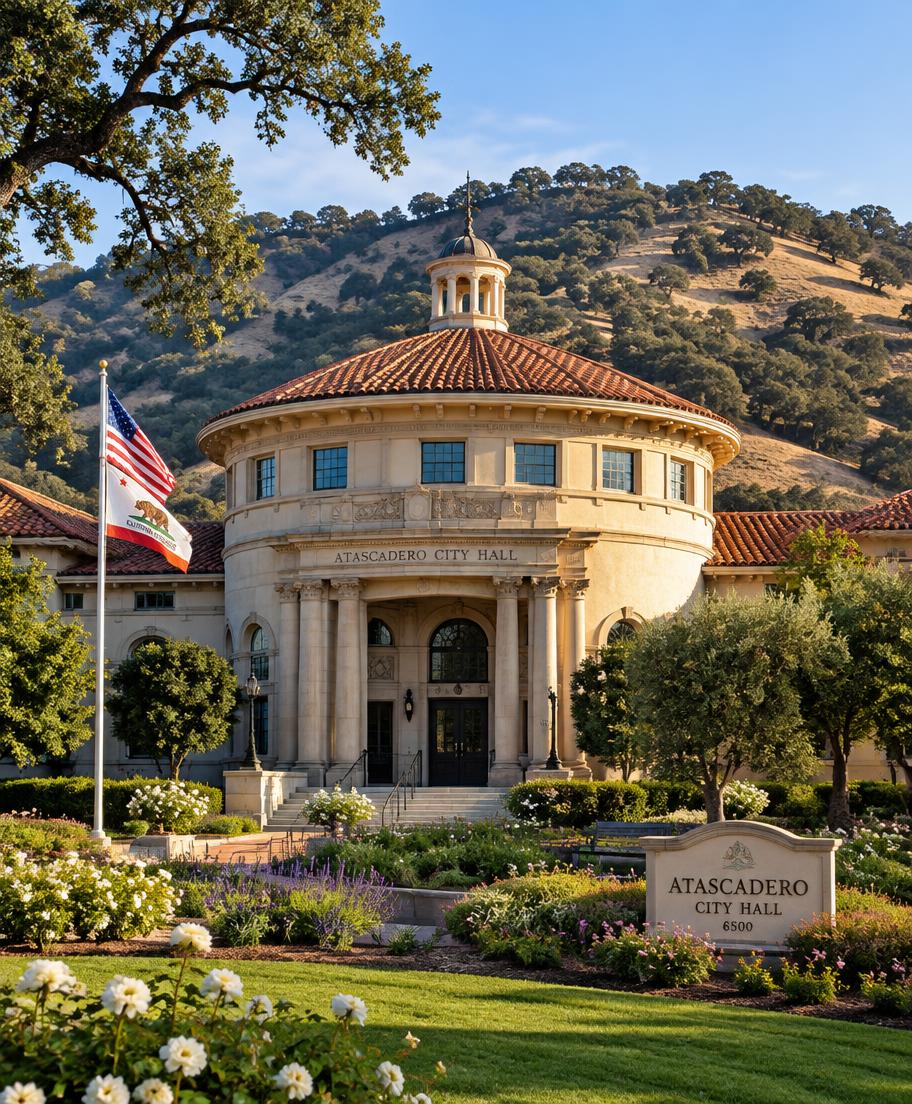
Atascadero sits along U.S. Highway 101 and El Camino Real, between the Salinas River and the oak-covered Santa Lucia Mountains, roughly midway between Paso Robles and San Luis Obispo. The city offers a small-town atmosphere with a walkable downtown, historic civic buildings, and the Sunken Gardens area in front of the domed Historic City Hall.
The city is known for Atascadero Lake Park, home to the Central Coast Zoo (formerly the Charles Paddock Zoo) — the only Association of Zoos and Aquariums–accredited zoo in San Luis Obispo County — along with paddle boating, fishing, and walking trails. Downtown Atascadero offers shops, restaurants, Colony Cinemas, and family entertainment within walking distance.
Atascadero's identity is rooted in its origin as a planned community: much of its layout, civic architecture, and community ethos trace directly back to founder E.G. Lewis's early-20th-century vision, which the city continues to celebrate through historical tours and preserved colony-era buildings.
The history
Where it began
The Salinan people lived throughout the area long before European contact; they called themselves the 'Te'po'ta'ahl,' or 'People of the Oaks.' In 1845, Mexican governor Pío Pico granted nearly 40,000 acres of the Asunción Rancho to Pedro Estrada, part of which became the roughly 23,000-acre Atascadero Rancho, later consolidated under J.H. Henry.
In 1913, publisher Edward Gardner (E.G.) Lewis purchased the Atascadero Rancho from Henry and began developing it as a planned 'colony' community, recording the largest single subdivision map in San Luis Obispo County at the time. The transfer ceremony took place on July 4, 1913, before roughly 3,000 attendees. Lewis hired agricultural, engineering, and planning experts to design the colony, with home construction beginning around 1915.
Atascadero remained an unincorporated community for decades before becoming the seventh incorporated city in San Luis Obispo County in 1979, making it the county's second-largest city. Many of Lewis's original community-planning principles were written into the city's first general plan. Historic landmarks from the colony era include the domed Historic City Hall and the Colony House Museum, an original 1919 colony home maintained by the Atascadero Historical Society.